

The Real Ceiling on Your Project Capacity (and Why More Discipline Won't Raise It)
Table of Contents
This is the first in a 4-part series on how working mix engineers and producers are restructuring the way they run projects as their client rosters grow — not by working faster, but by changing what actually has to happen to move a project forward. This piece looks at capacity: how many projects you can realistically run at once, and what actually sets that number. The next three cover running a level-matched A/B comparison without the usual DAW hassle, what actually changes in the client experience when you move off email and Dropbox, and how communication holds together across a project’s full lifecycle.
How many projects can you actually run right now?
Try this: pull up your current client list in your head. For each active project, answer three things without opening anything — no inbox, no folder, no messages app.
- What stage is it at?
- What was the last thing that happened on it?
- What needs to happen next?
If you got through that list cleanly, you’re probably running two or three projects. If you had to stop, open something, and scroll to reconstruct the answer — that reconstruction is the actual bottleneck. Not the mixing, not the editing, not the revisions themselves.
The tax you’re paying is the mental work of rebuilding context every time you switch back to something you set down. That tax is invisible on any single project. It becomes the whole ballgame once you’re running six, eight, ten things in parallel.
Why Discipline Can’t Reduce the Mental Stress
This isn’t a discipline problem. Most engineers who’ve been doing this a while already have naming conventions and revision numbering figured out. The real issue is that none of the tools involved store what stage a project is in.
Email doesn’t have a concept of “project stage.” Neither does Dropbox. A folder full of files with a chat thread next to it tells you what was sent, not where things currently stand. So “where things stand” defaults to living in your memory, rebuilt from timestamps and scrollback every time you need it.
That works fine at low volume, but it doesn’t scale because your memory doesn’t get bigger as your roster does.
How to Better Track Projects
Here’s a practice that works regardless of what tools you’re using — a spreadsheet, a whiteboard, sticky notes. It comes down to three pieces:
- Give every active project one current status, pulled from a short, fixed list — something like awaiting client, revision needed, in progress, approved. One word you can scan, not a paragraph.
- Attach feedback to the specific version it’s about, not to a general thread. “Pull the vocal back” is useless without knowing which version of the mix it refers to.
- Let status update as a side effect of the real action, not as a separate note you write to yourself afterward.
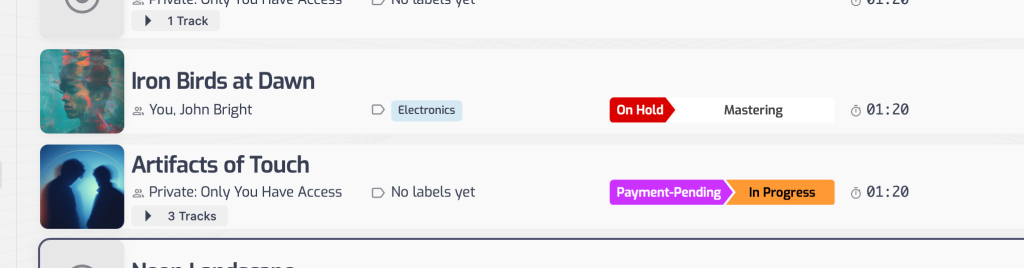
The first two you can bolt onto almost any setup with a bit of discipline. The third is the one that resists being retrofitted onto email or Dropbox — and it’s the actual ceiling.
Where manual tracking hits a wall
At two or three concurrent projects, updating a tracker by hand is no big deal. At eight or ten, the tracker itself becomes a second job. You’re not just doing the engineering work anymore — you’re also the person responsible for noticing a client replied, translating that reply into a status change, and going and updating a separate record to reflect it.
That translation step is where things fall apart. It isn’t that doing it by hand is slow. It’s that a spreadsheet or a board has no structural connection to the email thread it’s supposed to represent — nothing forces the two to stay in sync. Every status change depends on you personally noticing an event and copying it over, and the number of times you have to do that scales directly with how many projects you’re running.
That’s a ceiling effort doesn’t move. You can get better at checking your inbox. You can’t make a spreadsheet notice a client’s reply on its own.
The Better Way to Handle Projects in Parallel
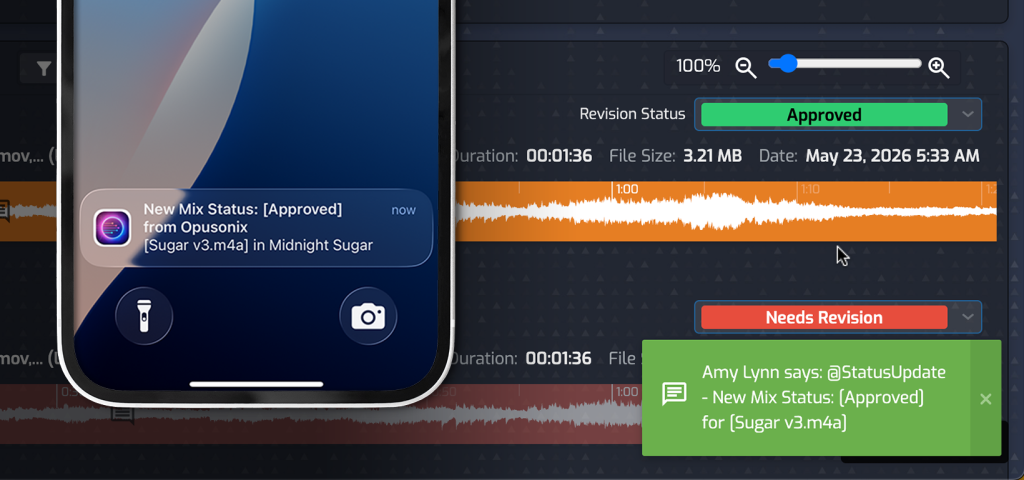
This is the idea behind Opusonix. A mix upload isn’t just a file drop — it’s what sets the project’s status to “pending review.” A client’s approval isn’t a message you interpret and then go update something else about — the approval is the status change, recorded the moment it happens. There’s no second system to keep in sync, because the file and its state are the same object.
The Takeaways
- Capacity is capped by reconstruction cost, not by how fast you mix.
- A manual tracker scales linearly with your own attention — that’s the wall, no matter how organized you are.
- Raising the ceiling means state living inside the work itself, not next to it in a separate record you maintain by hand.
Coming up in this series
Part 2 — Level-matched A/B comparison isn’t a new idea; it’s standard practice for a fair mix comparison. What’s hard is where you run it: email can’t do it at all, and setting it up in a DAW is enough of a hassle — plus the note-taking is messy while you’re doing it. Putting it directly in the review, next to your comments, is what makes it usable day to day.
Part 3 — What your client actually experiences on their end of a project, and what changes when that experience moves off email, texts, and Dropbox links.
Part 4 — Communication is bigger than feedback. Automatic updates when a mix is ready or a project moves to its next phase, threaded discussion tied to a specific comment instead of a scattered reply, and an easy way to point a client straight at what they need to look at.