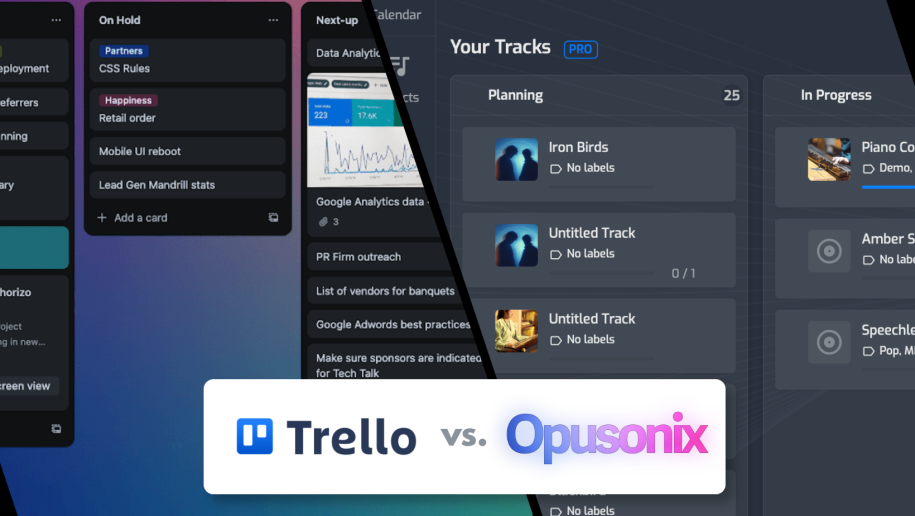
Trello vs. Opusonix: Which Is Better for Managing Music Production Projects?
Table of Contents
If you’re using Trello to manage music production projects, you’ve probably already made it work — custom boards, color-coded labels, cards for each track, maybe a checklist per deliverable. For producers who think visually and like staying organized, it’s a natural fit.
And for a while, it holds up.
But as projects get more complex — more collaborators, more revisions, more moving parts — the gaps start to show. This is where Opusonix, a project management platform built specifically for music producers, approaches things differently. Not because Trello is a bad tool — it isn’t — but because music production has specific needs that a general-purpose kanban board was never designed to meet.
Where Trello Genuinely Works
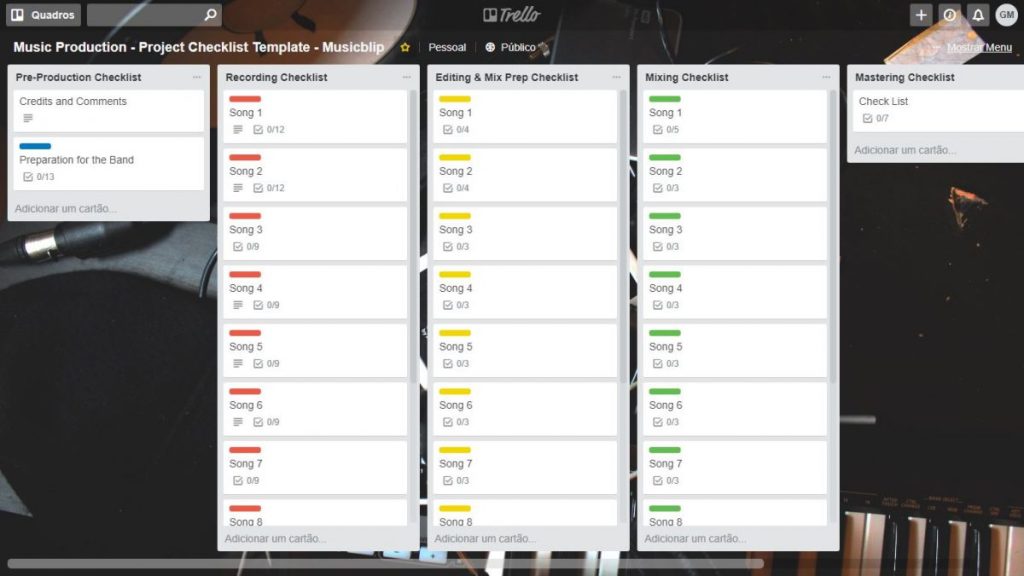
Trello’s core strength is visual pipeline management, and that translates well to music production. A board with stages like Writing, Recording, Mixing, Mastering, and Delivered gives you an immediate read on where every project stands. Moving a card feels satisfying. It’s simple, fast, and requires almost no onboarding for collaborators.
For solo producers managing a light workload, or for producers who just want a high-level view of their pipeline, Trello does that job well. The flexibility to design your own board structure means you can tailor it to how you actually work.
Where It Starts to Break Down
A card can’t play a mix. This is the fundamental limitation. A Trello card can hold a link to a mix, a comment about the mix, and a checklist of mix revisions — but you have to go somewhere else to actually listen. And when you’re somewhere else, you’re no longer in Trello. The feedback, the files, the conversation — they end up scattered.
Comments are just text. When an artist wants to flag something at 1:47 in the second verse, a Trello comment can’t capture that. “The bit after the hook feels too busy” is the best they can do. That kind of vague feedback costs time — both in follow-up questions and in the mix session trying to locate what they meant.
Version history isn’t built for mixes. You can attach files to a Trello card and update them over time, but there’s no native way to compare mix v2 and v3 side by side in real time. Producers end up managing that context manually — in card descriptions, in comments, or in their own memory.
Files don’t belong to anything. Attachments on a Trello card exist at the card level, not tied to a specific mix revision or a specific collaborator’s request. Over time, cards accumulate files with no clear structure, and finding the right version of the right file becomes its own task.
Collaborators see the board, not the project. When you bring in an artist or a mix engineer, you’re sharing a Trello board — which means they see everything, or you spend time configuring permissions. There’s no concept of a project-specific space where that collaborator’s role, their files, and their feedback all live together.
Where Opusonix Takes Over
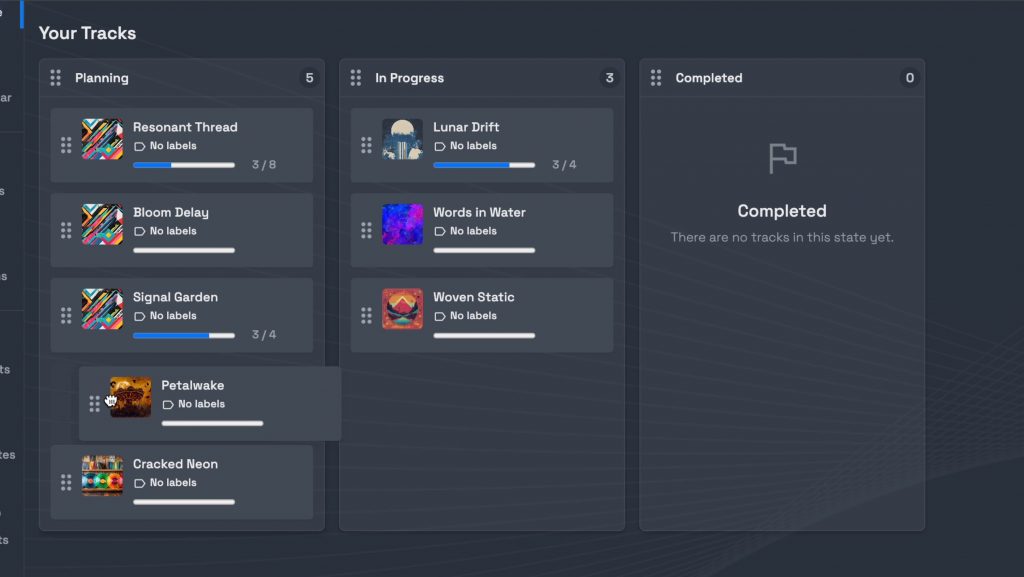
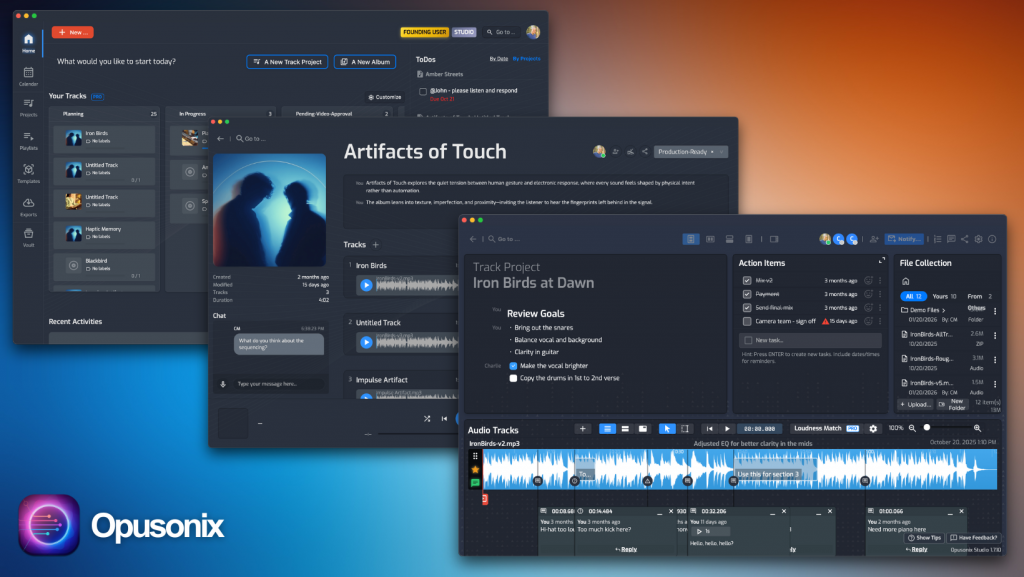
Opusonix has a global kanban board too — customizable stages, a full pipeline view across all your projects, the same visual clarity Trello delivers. That part isn’t a tradeoff.
The difference is what happens when you open a project.
Each track has its own dedicated workspace: notes, to-do lists, files, and mixes all in one place. When a new mix is uploaded, collaborators are notified automatically. They click one link and land directly on the track — where they can listen, leave timestamped comments at precise moments, react, reply, or record a voice message if typing isn’t their thing.
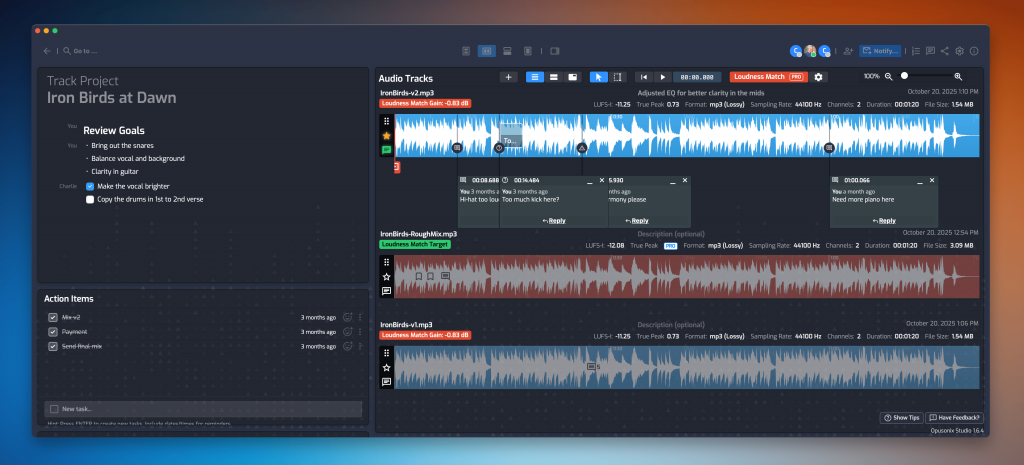
Mix revisions are stacked together automatically, with loudness-matched A/B playback. No links to manage, no version naming conventions to maintain. Everyone always knows which mix is current.
Role-based collaboration means producers can see feedback grouped by who left it — what the artist said, what the engineer responded. On a busy project with multiple contributors, that distinction matters.
And when the project is done, a single export action packages the right files and sends them to the right people. The download link expires after 7 days on its own, so there’s nothing for you to clean up.
The Verdict
Trello is a well-designed, reliable project management tool. If your main need is pipeline visibility and task tracking across projects, it’s hard to fault.
But music production isn’t just project management. It’s audio review, version control, file coordination, team communication, and final delivery — all happening around the music itself. Trello keeps track of the work. Opusonix keeps track of the work and the music, together, in the same place.
For producers who’ve stretched Trello as far as it goes and need a tool that understands what music projects actually involve, Opusonix is the natural next step.