
The Hidden Costs of Modern Audio Workflows (And Why Nobody Talks About Them)
Table of Contents
Most audio workflows work. Projects get finished. Files get delivered. Clients are (mostly) happy.
So what’s the problem?
The Current State
If you’re like most producers or audio engineers, your workflow probably looks something like this:
- DAW sessions on your local machine
- Files organized (more or less) in folders
- Feedback coming in through email, text, or messaging apps
- Mix revisions are shared via cloud drives with links exchanged via email or text
- More feedback gathered through various channels
- Final delivery through cloud storage links
Nothing unusual. Nothing broken.
But here’s the catch:
The way you’re managing projects is costing you more than time—you just can’t see it.
Because the real cost doesn’t show up as a single failure.
It shows up as friction—everywhere.
What feels like small friction isn’t small
Individually, these issues are easy to ignore.
Collectively, they shape how your projects feel, how your clients experience working with you—and even how your work turns out.
Let’s break that down.
1. Lost time → lost revenue
You’re not just “spending a few extra minutes” here and there.
You’re:
- digging through folders to find the right version
- retracing conversations to understand feedback
- double-checking files before sending
- context-switching between tools
None of this feels dramatic. But it adds up—fast.
And more importantly:
Every hour spent managing your project is an hour you’re not creating, refining, or taking on new work.
2. Cognitive load → creative fatigue
This is the part most people underestimate.
Every time you have to think:
- “Where did that feedback go?”
- “Which version is this?”
- “Did I already address this note?”
- “What exactly did the client mean by this?”
…you’re spending mental energy that has nothing to do with the music.
The more you manage the process, the less you can focus on the craft.
Over time, that constant overhead leads to:
- slower decisions
- reduced creative momentum
- more fatigue during sessions
Not because you’re doing anything wrong—but because your system is working against you.
3. Fragmented communication → client friction
When feedback is spread across:
- email threads
- text messages
- cloud comments
- verbal conversations
…clarity starts to break down.
Clients repeat themselves.
Details get missed.
Conversations lose context.
And even if everything eventually gets resolved, the experience feels harder than it should.
It’s not just inefficient—it subtly affects trust and collaboration.
4. Weaker feedback → weaker results
This is the hidden cost almost nobody talks about.
When communication is fragmented:
- ideas don’t build on each other
- feedback stays surface-level
- important nuances get lost
And that directly impacts the outcome.
Better collaboration leads to better decisions.
Better decisions lead to better mixes.
If the feedback loop is messy, the result often is too—whether you realize it or not.
The real issue isn’t your process
Individually, none of these problems seem critical.
But together, they create a pattern:
- more effort than necessary
- more friction than expected
- less clarity than you’d like
And most importantly:
They become “normal.”
You adapt. You work around them. You accept them as part of the job.
What’s actually missing
It’s not another plugin. It’s not more storage. It’s structure around everything that happens outside your DAW.
A way to:
- keep feedback connected to the work
- eliminate version confusion
- reduce constant context switching
- make collaboration feel clear and contained
A different way to run your projects
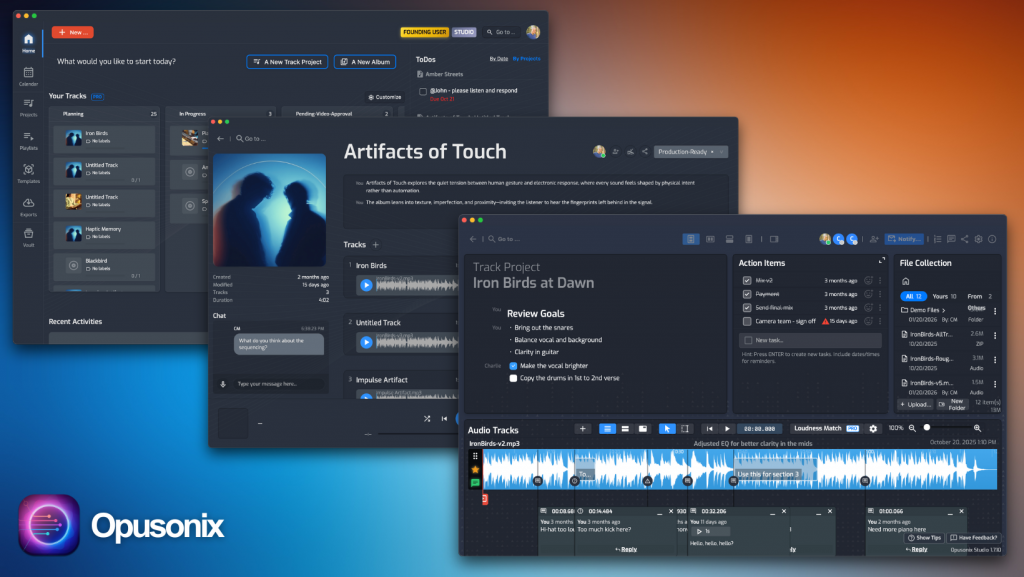
Opusonix isn’t another tool in your stack. It replaces the scattered system you’ve been relying on.
So instead of juggling folders, messages, and revisions across platforms, everything lives in one place—aligned with the project itself.
The result:
- less time managing
- less mental overhead
- better communication
- and more focus on the music
If any of this feels familiar, it’s not just you—it’s the system.
See what your projects look like without the friction.