
How to Manage Multiple Music Projects Without Burning Out
Table of Contents
For mix engineers and composers, the challenge isn’t just doing great creative work. It’s managing multiple music projects at the same time without burning out.
When you’re juggling several collaborations, the real strain often comes from mental overhead. Remembering which version is current. Tracking feedback scattered across emails, cloud comments, and messages. Reconstructing where you left off on a track after spending two days on another one.
Cloud storage solved file transfer. It did not solve music collaboration.
The Hidden Cost of Context Switching
Every time you switch between projects, you pay a small mental tax. You have to reload the context: what was discussed, what still needs revision, what feedback hasn’t been addressed. Or even more painful: just what exactly did you do with that one mix revision?
With one project, this is manageable. With four or five running in parallel, it compounds quickly.
That’s when small mistakes creep in:
Missing a comment buried in an email thread
Sending the wrong mix version
Reworking something that was already approved
Even when those mistakes are minor, the mental friction adds up. Over time, that friction contributes to stress and burnout more than the creative work itself. And then: a client comes to you asking for the final mix for a project from a year ago.
The problem isn’t a lack of discipline. Most experienced engineers already have naming conventions, folder hierarchies, and revision systems. The issue is that the context of a project still lives partly in your head and partly across multiple tools.
That fragmentation limits how many music projects you can realistically manage at once.
Why Structure Matters in Music Collaboration
If managing multiple music projects depends on memory and scattered communication, there is a ceiling to your capacity.
Structured collaboration changes that.
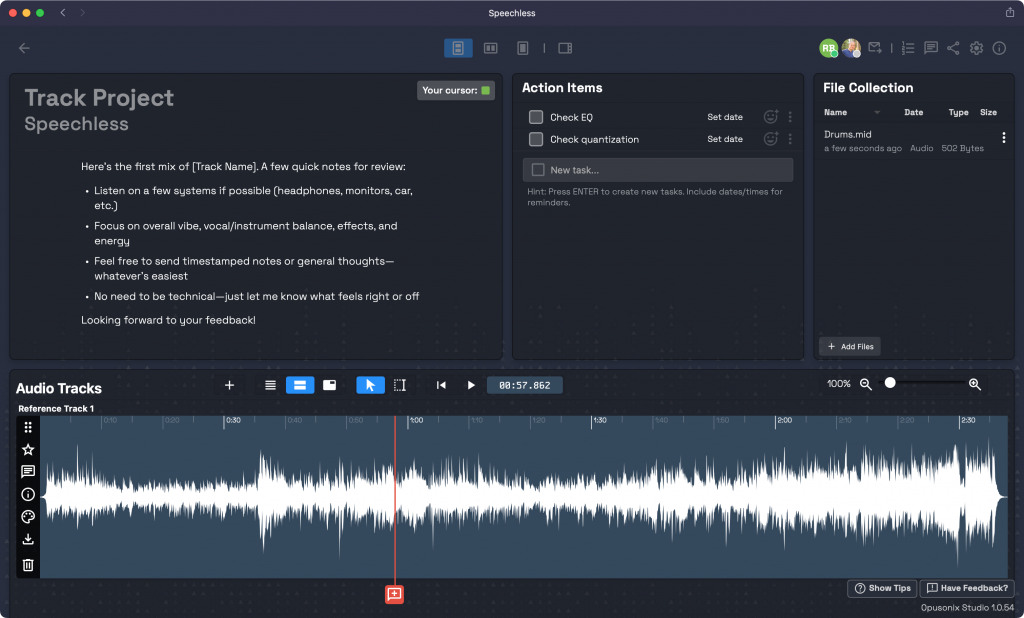
When each project has its own contextualized workspace — where mixes, notes, feedback, and decisions are stored together — you don’t have to mentally reconstruct the state of the project every time you return to it.
You simply open the workspace and the context is already there.
This doesn’t just streamline a mix review workflow. It changes how you handle concurrent projects. The time saved isn’t only in file organization; it’s in reduced mental switching cost. You re-enter creative mode faster, make clearer decisions, and avoid unnecessary back-and-forth.
A Real-World Insight from Crunch Time
One composer recently reflected on producing an album using Opusonix:
“Opusonix did make the mix review process streamlined and easier. But beyond the convenience factor, the biggest game changer I’ve found is that, when my engineer and I got to the crunch time where multiple tracks are due soon, Opusonix allowed us to switch between tracks with minimal mental overhead. Everything was stored neatly within their own workspace, so we can jump between tracks without spending extra time to relocate where we were. We wouldn’t be able to do this type of concurrent project undertaking in such a short amount of time.”
That insight captures the larger shift.
It’s not just about cleaner feedback. It’s about enabling true parallel work during high-pressure phases of a project.
Without structure, managing multiple tracks under deadline becomes chaotic. With structured music collaboration, it becomes controlled.
Increasing Capacity Without Increasing Chaos
Taking on more music projects does not have to mean longer hours or higher stress.
When collaboration is centralized and contextualized:
You spend less time searching and reconstructing
You reduce small but costly mistakes
You maintain clarity across revisions
You communicate with greater confidence
Over time, that clarity increases your practical capacity. You can manage multiple music projects more sustainably, protect the quality of your work, and build stronger client relationships.
The goal isn’t simply to work faster. It’s to create a workflow that supports your craft rather than draining it.
If your current process requires you to hold too much in your head, it may be worth asking whether your music collaboration structure is helping you grow — or quietly limiting how much you can take on.